Showing posts with label Hakka. Show all posts

Friday, April 17, 2009

Ethnic equality can only come through Language equality

Taiwan is a diverse nation. The homeland of the Austronesian peoples, it still can claim the greatest diversity of Austronesian languages around the world. But native speakers are dwindling fast with the relentless onslaught of a China-focussed Chinese Nationalist Party that has always ruled the legislature since it seized power in Taiwan in 1945. It organized the educations system to promote a "Greater China" ideology that sought to erase any loyalty to local cultures in Taiwan -- basically any non-Mandarin cultures -- whether Hakka, Hoklo, or any of the 13 14 government-recognized Austronesian people groups in Taiwan. The school systems around the nation are still functionally restricted to Mandarin-only instruction through both momentum of the education culture of the "prestige" Mandarin environment, and also through the culpable neglect or even suppression of any attempts to expand a non-Mandarin learning environment.


A recent example in the legislature where the ruling party was confronted for its elitist dismissive attitude towards Taiwan's non-Mandarin languages


Under the Tân Chúi-píⁿ (Chen Shui-bian) administration (2000-2008), a one-hour per week mother-tongue class was added in the elementary school. But that is not enough. Information and knowledge must be taught in other languages. Works must be written and read in other languages for the languages to be preserved in this era.

"What are the most important factors in the survival and spread of a language? The crucial point is to sustain and grow the speaker community. This may be done by natural growth in a fertile environment -- which may be quite an exploitative and objectively ruthless process, if the environment has been obtained through conquest and dispossession. But it may also be achieved through taking over another advanced community, as French spread in the 18-19th-century Russian high society; there, competence in a new language, symbolic of interest in new developments, was no threat to the substrate language, Russian. Provided that their speaker populations stay physically robust, the only threat to a language comes from a decline in speaker attitudes toward it: speakers must associate it with a least some of their daily needs or higher aspirations..." (emphasis added) - Nicholas Ostler in an interview with the California Literary Review, 6/1/2005

Ethnic equality will only come through language equality. Until that happens, there will be an inexorable degradation and exponentially decreasing population of any cultures other than the current prestige language and culture in Taiwan.

Chi Chun-chieh, Associate Professor at the Institute of Ethnic Relations at National Dong Hwa University write on the issue in a recent opinion editorial.

What can be done since the KMT-controlled legislature is intransigent on this issue?

* Use non-government organizations to give respect, honor and prestige to the non-Mandarin language teachers in Taiwan.

* Encourage each non-Mandarin language-community to develop their own wikipedia language encyclopedia. There is already one for Hoklo Taiwanese.

* Organize students in mother-tongue classes and societies in upper elementary, middle, and high school to regularly add entries to both wikipedias and wiktionaries. (As these students see a result and a value, they will continue to pursues studies in their mother-tongues.)

* Develop video production student organizations to produce Youtube reports and video pieces in their non-Mandarin mother tongues. (N.G.O's could award prizes such as computers and video cameras and editing software to poor communities specifically for student-produced video material in the non-Mandarin mother-tongues of Taiwan.)

* Set-up publishing funds and prizes for non-Mandarin literature in Taiwan.

* Create non-Mandarin bloggers associations to cross link and encourage weekly blogging articles in the non-Mandarin languages of Taiwan.

* Set up joint non-profit mother-tongue language and cultural promotion offices around Taiwan. Have these offices to be provide libraries and also the available purchase of non-Mandarin mother-tongue language material -- video, audio, and printed matter. However large or small these offices are, special attention should be paid to the interior design to instill a high class, high culture, prestige to these languages that they will be valued.

* Create a nation-wide catalogue and online ordering center for non-Mandarin mother-tongue works.

* Christian churches need to also take responsibility, because they are one element of community-level organization. For the Christian population in Taiwan, translate the children's catechism (question & answer) from Mandarin and English into the non-Mandarin languages, In non-Mandarin churches around the nation, have part of the curriculum for the children to be catechism drills. They will learn both language and Bible teachings. For the youth, help them learn and encourage singing and Bible reading in the mother-tongue.

=========================================

Monday, February 23, 2009

International Mother-Tongue Day


Saturday, February 21 was United Nations designated International Mother-Tongue Day. The Ministry of Education held an event to give out awards for those who worked to advance the cause of Local Languages -- Hoklo Taiwanese, Hakfa and the Austronesian languages of Taiwan. It felt a little bit strange that an event was held in a building on Heping East Road in Taipei where formerly much energy devoted to the suppression or even eradication of languages other than Mandarin.

13 Hoklo Taiwanese language award recipients included Tīⁿ Ji-gio̍k 鄭兒玉 author of many poems and songs. Among the most famous are (1) Taiwan's as of yet unofficial national anthem: "Tâi-ôan Chhùi-chhiⁿ" or "Verdant Taiwan" set to music by the most famous Taiwanese composer of his generation -- Siau, Thài-jiân 蕭泰然 . [This national anthem has versions in Hoklo Taiwanese, Hakka, Amis and Mandarin] and also (2) "Lán sī Tâi-oân Chú-lâng" or "We the People are the Sovereigns of Taiwan" now with versions in Hoklo Taiwanese, Hakka, Paiwan, Tayal, Amis and Mandarin

10 Hakka received awards -- the majority, elementary school teachers.

Only 3 Austronesian teachers received awards -- all of them from the Tayal Austronesian people. A Tayal teacher and pastor from the mountain villages of I-Lan as well as a Tayal teacher from the mountains in Taoyuan both told me how they were very disappointed that there were not others from other Austronesian language groups present. They each told me -- there should be thirteen people up there from every single Austronesian people group in Taiwan.

Every award recipient with whom I spoke -- Hoklo, Hakka and Tayal alike -- told me that the Ministry of Education's policy of having a mother-tongue language class once per week for one hour at each elementary school was insufficient. They agreed that the next generation of children need to learn to read and write the mother-tongue and that different school subjects and classes should be taught using the mother-tongue for it to not disappear as an extant language within a few generations.

Several quite excellent music and culture groups performed in between award presentations. I was particularly happy to see young children very expertly performing with puppets, voice and instrumentation classical Hoklo Taiwanese puppet theater. Additionally a Rukai female vocal artist accompanied by a guitarist sang one Rukai song and one of her own Mandarin-language composition. The Rukai song was a traditional one. It does not seem many new songs are being composed in the language. An entire team of young men and women Tayal dancers and percussionists performed some traditional Tayal chants. One cutesy bubble-gum pop-princess-type young Hakka woman sang a Hakka song for children, but she kept using a lot of Mandarin to explain things and lead the singing. It says a lot about the failure of the current system if in order to get Hakka children to sing a Hakka song properly, they must be instructed in Mandarin.

There is very little incentive in society for young people to learn any languages other than Mandarin so long as the government continues to elevate Mandarin as the prestige and "national" language and does not accord these other languages respect and equal treatment. How to do so? • Declare all Taiwan's languages "national" languages. • Increase the pay of "local-language" teachers • Implement a policy that at least half the instruction in elementary schools be done in the local language instead of Mandarin. • Rename roads and parks. Encourage the posting of street signs and naming of roads in the local language. Get rid of all those Chung-Shan roads or San-Min roads or Chung-Cheng road-names and let them be replaced in each township with a word or name of a person from their own mother-tongue -- or even the name of the mother-tongue itself. As Taipei has a Ketagalan Boulevard, we should see Kavalan and Tayal Boulevards in I-Lan, etc. What is more, we should be commemorated the names of all of the plains-Austronesian people groups who took on Han surnames and Manchu dress customs and were absorbed -- like the Siraya, Babuza, Pazeh, etc. And in Austronesian areas, roads and parks should be named after historical or famous Austronesian people. • Established endowed professorships at universities for research, study, preservation, and renewal of Austronesian language and culture. • Encourage the writing and publishing of these languages.

The blog, sia-taiwan.blogspot.com was founded precisely to encourage writing in Taiwan's languages other than Mandarin. Here is an article on written Hoklo Taiwanese literature. I myself have begun tackling the great philosophical work of scholar and patriot Chhòa Pôe-hóe 蔡培火 from 1925 Cha'p-hāng Koán-kiàn, "An Opinion on Ten Matters." It was recently republished by the Taiwan Church Press in November of 2008. The entire work is in romanized Taiwanese. Not a single Han Character can be found in its 150 pages.

If you would like to devote resources and time to supporting these non-Mandarin languages in Taiwan, one place you could start would be to contact the Taiwanese Presbyterian Church's General Assembly Headquarters in Taipei. [article on some of its language-promotion work.] Some of the primary work especially among the Austronesian languages is done by Austronesian Presbyterian pastors. Though you might not see them for sale on the first floor bookstore, entire Bibles translated into Austronesian languages can be purchased if asked. I am aware of an Amis Bible and a Tayal Bible, but there is probably access to others. Also, on the 7th floor library, you can get access to the longest running Hoklo Taiwanese newspaper called the Taiwan Church News which until the 1970's was published in the POJ Taiwanese Romanization.

And of course, you can learn to speak one of these local non-"national" languages. With a friendly manner, greet other people and use the local language that you have learned first in conversation. Then if the other person cannot understand, switch to Mandarin. That will show a priority and a prestige and make others feel a lack of knowledge and maybe develop a desire themselves to go learn. (If the world-over all recognize the word "Aloha" from Hawaii, we in Taiwan (Hawaiiki) should at least learn how to give a word of greeting in each and every non-Mandarin language of Taiwan.)

The Maryknoll Language Institute provides one-on-one instruction and publishes Hakka and Hoklo Taiwanese language learning textbooks as well as Taiwanese-English and English Taiwanese dictionaries. The Taipei Language Institute publishes a Taiwanese-English dictionary. These can be found at the Taiwan Shop in Taipei as well as SMC Publishing. Both stores within a short block of each other carry a large selection of works in non-Mandarin languages. You can even find works and dictionaries there of extinct languages of the assimilated Austronesian plains-tribes.

As I compile more links or resources, I'll put them up here.

On the whole we can no longer trust or rely on the government to remedy the situation. We must push them as much as possible, but we need to set up completely separate and distinct non-government bodies to carry the load of promoting the language. We must organize local organizations and especially local communities to make changes themselves in their own schools and daily lives. And in our individual lives, we can take steps each day that might create ripples that grow exponentially in this society to effect change.

- Joel Linton

======
Here is an example that the current KMT government is really only concerned with promoting Mandarin and will do only as much as is politically necessary with regard to other languages. "Premier Liu Chao-shiuan (劉兆玄) yesterday ... his remark that children should learn mother tongues other than Mandarin at home “instead of taking up too many hours at school.”

Thursday, June 26, 2008

The real story of the settlement of Taiwan's peoples

Many people have been taught the often repeated myth that goes like this: The Austronesian aboriginal tribes used to live in the plains of Taiwan. But then the Hakka came across the Taiwan Strait from China and pushed them back to the foothills. Then the Fujianese (Hoklo) came and pushed the Hakka to the foothills and the Austronesians to the mountains where they began to be called the "mountain tribes." This simplistic myth was probably pushed by the KMT dictatorship era to safeguard the prestige and claimed ethnic superiority of Han Chinese, to somehow say that the Chinese-derived language speakers of Taiwan have always been "Chinese," "blood is thicker than water," and all those claims to somehow say that Taiwan belongs to China.

This whole caricature of Taiwanese history is simply not true. Recent genetic studies have shown that 80 percent of Taiwan's population also have Austronesian ancestry (basically all of those who did not come over with the Chinese refugees in 1949).

Here is a more accurate account of Taiwan's history. Before Chinese immigrants came to Taiwan, Taiwan's mountains, foothills and plains were already populated by a multitude of Austronesian tribes and languages. Population density was varied, but there were settlements in every type of area of Taiwan.

First the Dutch came in the early 1600's and began to exert control over some parts of western Taiwan. They wanted a steady tax base, so they imported mostly Fujianese (Hoklo) laborers along with water buffalo to create an intensive rice agricultural economy in the flatlands. Before this time, there was no significant Chinese presence. Chinese pirates maintained a few bases in estuaries on the west coast.

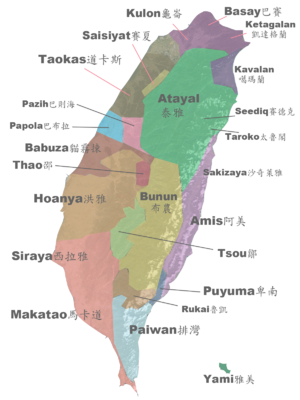
At the end of the Dutch era, along with Koxinga, Hoklo immigrants came in greater numbers. By the 1700's Taiwan's west coast had come under the control of the Manchu empire. The Manchu regime did not want Chinese immigrants to settle in Taiwan so they only allowed men without their families to cross the Taiwan Strait to work. So naturally these men took Austronesian wives. Also, as the Chinese population grew in Taiwan, it became the dominant culture and the plains tribes gradually were assimilated and took on Chinese surnames. Various Hakka groups also crossed the Taiwan Strait and as they were already used to an upland economy based on mining and indigo and the farming of other upland crops, they came and settled the cheap wastelands of the hills, but were able to make them productive. There was some dislocation of Austronesian tribes, but on the whole the Austronesian plains tribes did not move to the mountains; they assimilated and became what is now the Hoklo and Hakka speaking populations of the majority of the people of Taiwan, now called "Taiwanese". Examples include the Siraya, Pazeh, Ketagalan, Kavalan, etc. to name a few.

Here is an article about how the Pazeh Austronesian tribe that assimilated in the early 1900's is seeking now to take back their language and culture.

A similar thing is happening in Tainan with descendents of the assimilated Siraya tribes who took on very unique Chinese surnames when they lost their own cultures. On July 4-7, 2008, they gathered to plan on reviving the now dead Sinkang Siraya language that their ancestor's spoke. They have begun publishing material in Siraya. You can see here how they realize that a language in these present times must be written, not just spoken, to have a hope of being revived. [Contact information: Uma Talavan (06)580.0992 , musuhapa at hotmail.com]


Here is a link to the map of Taiwan showing the distribution of Austronesian languages, even the ones that were culturally obliterated by Sinification.