Thursday, February 26, 2009

Taiwan Austronesian Dictionary

The Taiwan Shop has for sale a set of Amis-Mandarin and Mandarin-Amis dictionaries. This dictionary was completed in 2007. Such a dictionary is important for the preservation of the language. The next step would be to create a dictionary where the Amis word definitions were also written in the Amis language. Right now there also is an Amis-language Bible. Someone familiar with this Austronesian language should use the dictionary to set up a Wikipedia Amis language site as well as a Wiki Dictionary. Would that not be an excellent graduate linguistics project? A wikipedia site would be a place of connection for all the language speakers and an encouragement for the younger generation to get involved.

Hahawikideng A Cudad No 'Amis (Amis-Mandarin Dictionary)
ISBN: 978-986-83786-1-2
Publ. Kaohsiung, TAIWAN, September 2007

O Pitiri 'An To Sawal No 'Amis (Mandarin-Amis Dictionary)
ISBN: 978-986-83786-2-9
Publ. Kaohsiung, TAIWAN, September 2007

Author's contact information:
sasimiwasapi @ yahoo.com.tw
tel: 07-841-633

Monday, February 23, 2009

International Mother-Tongue Day


Saturday, February 21 was United Nations designated International Mother-Tongue Day. The Ministry of Education held an event to give out awards for those who worked to advance the cause of Local Languages -- Hoklo Taiwanese, Hakfa and the Austronesian languages of Taiwan. It felt a little bit strange that an event was held in a building on Heping East Road in Taipei where formerly much energy devoted to the suppression or even eradication of languages other than Mandarin.

13 Hoklo Taiwanese language award recipients included Tīⁿ Ji-gio̍k 鄭兒玉 author of many poems and songs. Among the most famous are (1) Taiwan's as of yet unofficial national anthem: "Tâi-ôan Chhùi-chhiⁿ" or "Verdant Taiwan" set to music by the most famous Taiwanese composer of his generation -- Siau, Thài-jiân 蕭泰然 . [This national anthem has versions in Hoklo Taiwanese, Hakka, Amis and Mandarin] and also (2) "Lán sī Tâi-oân Chú-lâng" or "We the People are the Sovereigns of Taiwan" now with versions in Hoklo Taiwanese, Hakka, Paiwan, Tayal, Amis and Mandarin

10 Hakka received awards -- the majority, elementary school teachers.

Only 3 Austronesian teachers received awards -- all of them from the Tayal Austronesian people. A Tayal teacher and pastor from the mountain villages of I-Lan as well as a Tayal teacher from the mountains in Taoyuan both told me how they were very disappointed that there were not others from other Austronesian language groups present. They each told me -- there should be thirteen people up there from every single Austronesian people group in Taiwan.

Every award recipient with whom I spoke -- Hoklo, Hakka and Tayal alike -- told me that the Ministry of Education's policy of having a mother-tongue language class once per week for one hour at each elementary school was insufficient. They agreed that the next generation of children need to learn to read and write the mother-tongue and that different school subjects and classes should be taught using the mother-tongue for it to not disappear as an extant language within a few generations.

Several quite excellent music and culture groups performed in between award presentations. I was particularly happy to see young children very expertly performing with puppets, voice and instrumentation classical Hoklo Taiwanese puppet theater. Additionally a Rukai female vocal artist accompanied by a guitarist sang one Rukai song and one of her own Mandarin-language composition. The Rukai song was a traditional one. It does not seem many new songs are being composed in the language. An entire team of young men and women Tayal dancers and percussionists performed some traditional Tayal chants. One cutesy bubble-gum pop-princess-type young Hakka woman sang a Hakka song for children, but she kept using a lot of Mandarin to explain things and lead the singing. It says a lot about the failure of the current system if in order to get Hakka children to sing a Hakka song properly, they must be instructed in Mandarin.

There is very little incentive in society for young people to learn any languages other than Mandarin so long as the government continues to elevate Mandarin as the prestige and "national" language and does not accord these other languages respect and equal treatment. How to do so? • Declare all Taiwan's languages "national" languages. • Increase the pay of "local-language" teachers • Implement a policy that at least half the instruction in elementary schools be done in the local language instead of Mandarin. • Rename roads and parks. Encourage the posting of street signs and naming of roads in the local language. Get rid of all those Chung-Shan roads or San-Min roads or Chung-Cheng road-names and let them be replaced in each township with a word or name of a person from their own mother-tongue -- or even the name of the mother-tongue itself. As Taipei has a Ketagalan Boulevard, we should see Kavalan and Tayal Boulevards in I-Lan, etc. What is more, we should be commemorated the names of all of the plains-Austronesian people groups who took on Han surnames and Manchu dress customs and were absorbed -- like the Siraya, Babuza, Pazeh, etc. And in Austronesian areas, roads and parks should be named after historical or famous Austronesian people. • Established endowed professorships at universities for research, study, preservation, and renewal of Austronesian language and culture. • Encourage the writing and publishing of these languages.

The blog, sia-taiwan.blogspot.com was founded precisely to encourage writing in Taiwan's languages other than Mandarin. Here is an article on written Hoklo Taiwanese literature. I myself have begun tackling the great philosophical work of scholar and patriot Chhòa Pôe-hóe 蔡培火 from 1925 Cha'p-hāng Koán-kiàn, "An Opinion on Ten Matters." It was recently republished by the Taiwan Church Press in November of 2008. The entire work is in romanized Taiwanese. Not a single Han Character can be found in its 150 pages.

If you would like to devote resources and time to supporting these non-Mandarin languages in Taiwan, one place you could start would be to contact the Taiwanese Presbyterian Church's General Assembly Headquarters in Taipei. [article on some of its language-promotion work.] Some of the primary work especially among the Austronesian languages is done by Austronesian Presbyterian pastors. Though you might not see them for sale on the first floor bookstore, entire Bibles translated into Austronesian languages can be purchased if asked. I am aware of an Amis Bible and a Tayal Bible, but there is probably access to others. Also, on the 7th floor library, you can get access to the longest running Hoklo Taiwanese newspaper called the Taiwan Church News which until the 1970's was published in the POJ Taiwanese Romanization.

And of course, you can learn to speak one of these local non-"national" languages. With a friendly manner, greet other people and use the local language that you have learned first in conversation. Then if the other person cannot understand, switch to Mandarin. That will show a priority and a prestige and make others feel a lack of knowledge and maybe develop a desire themselves to go learn. (If the world-over all recognize the word "Aloha" from Hawaii, we in Taiwan (Hawaiiki) should at least learn how to give a word of greeting in each and every non-Mandarin language of Taiwan.)

The Maryknoll Language Institute provides one-on-one instruction and publishes Hakka and Hoklo Taiwanese language learning textbooks as well as Taiwanese-English and English Taiwanese dictionaries. The Taipei Language Institute publishes a Taiwanese-English dictionary. These can be found at the Taiwan Shop in Taipei as well as SMC Publishing. Both stores within a short block of each other carry a large selection of works in non-Mandarin languages. You can even find works and dictionaries there of extinct languages of the assimilated Austronesian plains-tribes.

As I compile more links or resources, I'll put them up here.

On the whole we can no longer trust or rely on the government to remedy the situation. We must push them as much as possible, but we need to set up completely separate and distinct non-government bodies to carry the load of promoting the language. We must organize local organizations and especially local communities to make changes themselves in their own schools and daily lives. And in our individual lives, we can take steps each day that might create ripples that grow exponentially in this society to effect change.

- Joel Linton

======
Here is an example that the current KMT government is really only concerned with promoting Mandarin and will do only as much as is politically necessary with regard to other languages. "Premier Liu Chao-shiuan (劉兆玄) yesterday ... his remark that children should learn mother tongues other than Mandarin at home “instead of taking up too many hours at school.”

Monday, February 9, 2009

Latest on a Hollywood movie about Taiwan -- Formosa Betrayed


It is rumored that the producers had to hire a lot of Thai actors because the Taiwanese actors were afraid of how starring in this movie would affect their careers since they might be banned from audiences in China. This political thriller exposes the dark side of imprisonment and political killings of the era of martial law and one-party Leninist dictatorship in Taiwan presided over by Chiang Kai-shek and his son Chiang Ching-kuo. The people facing oppression were also the ones pushing not only for democracy but also for Taiwan's international status as a free and independent nation.

It is also interesting to note that much of the movie could not be filmed in Taiwan.

We look forward to the day when there will be an atmosphere of free speech where creative endeavors, even if they are critical of a government or political party's past, will be allowed to proceed. We look forward to the day when people in power are secure in their elected legitimacy that they do not feel the need to use their power to suppress artistic endeavors that are critical of them.

Even this teaser trailer itself is good for Taiwan's identity -- it specifically uses the word "nation" to describe Taiwan. In this age of entertainment and general ignorance of history and world affairs, we think this movie will be of great benefit in increasing global awareness and understanding of the current reality in Taiwan, its history, its international status, and the struggle of its people. It should also create a greater interest that will translate in to more tourism and international focus on Taiwan.

Thursday, December 18, 2008

Cape No. 7 Choice Taiwanese Quotes


If you can listen carefully and avoid being distracted by the English subtitles you will here many excellent Taiwanese expressions used by characters in the movie Cape No. 7.

Notice what Old Mao says in the scene when the two guitarists are considering replacing Old Mao with Malasun (the Hakka liquor salesman) on bass guitar. He is noting that they really want the Hakka guy to play the bass guitar because he is better than Old Mao, but they are reluctant to admit it to Old Mao. In English --- something like: "Don't fake." "Hungry as a ghost but pretending to be polite." And then he says that he is a "national treasure". [I'll go back and type in the exact Taiwanese words later.] Old Mao has the best comments and interaction and his character really shines through in the movie.

Another choice scene is when the town council representative (Aga's step-father) and his underlings are helping deliver the mail. They notice that Malasun is very diligently trying to sell his liquor across the street at an outdoor cafe. The driver of the car comments that that is nothing special because that is all Malasun knows how to do. His wording in Taiwanese is much more colorful: "Flies are always seeking the dung of dogs" -- it means -- that is just what flies do. It is nothing special.

Check back here for postings of more choice Taiwanese phrases from the movie.

Wednesday, November 12, 2008

High and Rich Cultures in the Non-Mandarin languages of Taiwan

This year we are beginning to see some good signs that Taiwan's cultures and languages are breaking free of the 100 years of suppression by the China-centric KMT authoritarian regime and the Japan-centric Japanese colonial era.

Films
* Wei Te-sheng (魏德聖) directed one of the most successful film of the year is "Cape No. 7" (海角七號), filmed in south Taiwan's Pingtung County Taiwanese Holo, Japanese and Mandarin languages.


* The director of Cape No. 7 had been working on a film project called "Seediq Bale" about Taiwan's Austronesian Seediq people in their war to maintain their freedom against the Japanese. With the success of Cape No. 7, the director my be able to produce a feature-length film (in Seediq and Japanese languages).

More Information: Taipei Times 2008/11/28

* Another film using the Hakka language & Japanese just came to theaters: "1895 in Formosa" (一八九五) about the defense of the first republic in Asia -- the Republic of Taiwan -- that did not last longer than a few months before Japanese troops came and conquered the pro-Taiwan fighters. It is reminiscent of the hopeless last-stand against overwhelming odds of the Alamo in United States history.


* And finally, there is an animated DVD out with many of the legends of Taiwan's Austronesian peoples. You can set the audio to Taiwanese Holo, Hakka, and Mandarin, and one of the legends also has audio in Tayal Austronesian language. It would be great if they could go ahead record the voices for the respective Austronesian language which corresponds to the source of the legend including: Saisiyat, Rukai, Tayal, Amis and Bunun


Operas

* The Black Bearded Bible Man - an epic on George Leslie MacKay, the first presbyterian missionary in North Taiwan. Taiwan's most famous young composer, Gordon Chin, spent five years working on this opera. The World Premiere will be performed in Taiwan's National Concert Hall on November 27, 28, 29 and 30th. It is sung not in Italian, not in Mandarin, but instead in Holo Taiwanese and English. Librettist Joyce Chiou wrote the piece with Ju-Fang Shih who wrote the Holo Taiwanese lyrics.

The lead actor, Thomas Meglioranza, writes in his blog about learning Taiwanese

Commercials
* Here's a commercial for one of Taiwan's largest computer companies in Taiwan, Acer. What's excellent about this commercial is that it vividly portrays the beauty of Taiwan's Austronesian cultures and lets us know what a loss it is that their cultural aesthetic has not greatly impacted Taiwan or penetrated its public education still dominated by Han Chinese chauvinism. Just think of how beautiful the art, architecture and fashion if leaders in these industries were to embrace and explore Taiwan's native cultures.


-------M------M------M------M------M------M------M------


I'll also mention a Mandarin-language film because it was (1) produced and filmed in Taiwan, (2) captures the strong classical music culture of Taiwan, (3) represents the creativity of the young generation of Taiwan's filmmakers, (4) shows college student culture, (5) was filmed on location highlighting the beautiful historic port of Tamsui in north Taiwan.

The movie is "Secret", directed by Jay Chou. It has a plot twist I think is much better than the M. Night Shyamalan blockbuster, The Sixth Sense, starring Bruce Willis.


-------E------E------E------E------E------E------E------E------


One English-language Hollywood movie, "Formosa Betrayed" is now in post production. It is a political thriller inspired by events in the earlier 1980's of assassination and political suppression during the authoritarian dictatorship of Chiang Kai-shek's son, Chiang Ching-kuo and his Chinese Nationalist Party (KMT)
Formosa Betrayed
http://www.imdb.com/title/tt1121786/

Here is a Bangkok TV interview at the film set. I'm very curious about the ultimate quality and story-line of this movie.

Tuesday, July 15, 2008

Dismissed as Dialects

Over the centuries, foreigners responded to their introduction to the strange writing system of China as well as the centralized authoritarian rule and prestige of the court language by lumping all of the languages of China into the idea of "dialects" of a single language.

They would purchase books published in China with Chinese characters to take back to European courts and libraries and just assumed they were the one written "Chinese language" and were so classified. How many volumes are sitting libraries that are erroneously thought to be works in Mandarin but which are actually written in other Han languages?

Many scholars read the word 官音 "kuan-yin" and translate it "Mandarin" instead of "court language." And then by Mandarin, they are actually thinking of this modern language used in Beijing and adopted as a national language in the 1900s. They seem not to account for the rise of fall of different dynasties, not to mention annexation by foreign empires (like the Mongols and Manchus) with totally alien languages. Would these new elites not completely alter the languages used at court just as William the Conqueror's Normans brought their own French language with them to England in 1066? Is the language used by the Manchu court, "Qing Dynasty," so similar to the Ming before it? How about the Mongol Khanate "Yuan Dynasty" before it? Surely these two foreign empires significantly altered pronunciation and word usage if not radically changing everything about the court languages in use of predecessor empires. One wonders whether so called "dialects" especially spoken in the south are not actually former court languages of prior dynasties whose refugees fled the new empire's minions.

This same bias towards the prestige language of Mandarin in Taiwan has left the next generation thinking there is no written form for their mother tongues whether Hakka, Holo Taiwanese, or the Aboriginal languages. Though they are literate in Mandarin, they are left illiterate in the language their grandparents speak at home. And also the ethnic Han elitism -- that considers an alphabetic script to be somehow merely a pronunciation aid instead of written words when compared with Chinese characters -- causes written works of these languages that used romanized phonemes to be basically dismissed as non-literature.


Following is a catalogue of works published in written Holo Taiwanese using the POJ romanization system. None of it is taught in the schools as part of Taiwan's literary heritage. Additionally, there is some scholarly work done on some printed books using Chinese characters in the 1600's -- mostly compilations of arias and plays -- that are actually written Holo Taiwanese using Han characters. Some of these books made their way to libraries in the Netherlands and England. You can actually purchase reprints of the works in a book published by SMC Publishing titled, The Classical Theatre and Art Song of South Fukien by Piet Van Der Loon, an Emeritus Professor of "Chinese" from Oxford University.


====================
1. Compilations of periodical: Tâi-oân-hu-sian Kàu-hōe-po (Taiwan Prefectural City Church News) from July 1885 through 1970
[These can be read at the 7th Floor Library of the General Assembly Office of the Presbyterian Church in Taiwan: No. 3,Lane 269, Roosevelt Road, Sec.3, Taipei,106 TAIWAN]


2. “Pit Soàn ê Chho. Ha'k” (Fundamental Mathematics) by Ui-lim Ge in 1897 [ 筆算的初學 … 倪為林 ]


3. “Lāi Gōa Kho Khàn-hō.-ha'k” (The Principles and Practice of Nursing) by George Gushue Taylor in 1917 ( 內外科看護學…戴仁壽 醫師)
[Chapter 1, 2, 3, 4, 5, 6, 7, 8, 9, 10, 11, 12, 13, 14, 15, 16, 17, 18, 19, 20, 21, 22, 23, 24, 25, 26, 27, 28, 29, 30, 31, 32, 33, 34, 35, 36, 37, 38, 39, 40]

4. the novel “Chhut Sí Sòaⁿ” (Line between Life and Death) by Khe-phoan Teⁿ in 1926

5. the collection of commentaries “Cha'p-hāng Koan-kián” (Opinions on Ten Issues) by Poe-hoe Chhoa in 1925

6. Compilations: Taibun periodicals such as Tâi-bûn Thong-sìn (台文通訊)

7. Compilations: Tâi-bûn Bāng-Pò (台文罔報) -- also uses Pe'h-oē-jī as the romanization for writing Taiwanese

8. This volume: --- " 5%台譯計劃.
In November of 1995, some Taiwanese youths who were concerned about the writing of Taiwanese decided to deal with the Taiwanese modernization and loanwords through translation from foreign language into Taiwanese. The organization 5% Project of Translation in Taiwanese was then established on February 24, 1996. It's members have to contribute 5% of their income every month to the 5% fund. The first volume includes 7 books. They are Lear Ông, Kui-a Be-chhia, Mi-hun-chhiun e Kui-a, Hoa-hak-phin e Hian-ki, Thin-kng Cheng e Loan-ai Ko.-su, Pu-ho.-lang e Lek-su, and Opera Lai e Mo.-sin-a, published by Tai-leh (台笠) press in November 1996."
- (Src: "Romanization and Language Planning in Taiwan" -Wi-vun Taiffalo Chiung)


-------
Good Links regarding Written Taiwanese:

tailingua.com
Siá Tâi-oân ê Oē
taigi.fhl.net

Thursday, June 26, 2008

The real story of the settlement of Taiwan's peoples

Many people have been taught the often repeated myth that goes like this: The Austronesian aboriginal tribes used to live in the plains of Taiwan. But then the Hakka came across the Taiwan Strait from China and pushed them back to the foothills. Then the Fujianese (Hoklo) came and pushed the Hakka to the foothills and the Austronesians to the mountains where they began to be called the "mountain tribes." This simplistic myth was probably pushed by the KMT dictatorship era to safeguard the prestige and claimed ethnic superiority of Han Chinese, to somehow say that the Chinese-derived language speakers of Taiwan have always been "Chinese," "blood is thicker than water," and all those claims to somehow say that Taiwan belongs to China.

This whole caricature of Taiwanese history is simply not true. Recent genetic studies have shown that 80 percent of Taiwan's population also have Austronesian ancestry (basically all of those who did not come over with the Chinese refugees in 1949).

Here is a more accurate account of Taiwan's history. Before Chinese immigrants came to Taiwan, Taiwan's mountains, foothills and plains were already populated by a multitude of Austronesian tribes and languages. Population density was varied, but there were settlements in every type of area of Taiwan.

First the Dutch came in the early 1600's and began to exert control over some parts of western Taiwan. They wanted a steady tax base, so they imported mostly Fujianese (Hoklo) laborers along with water buffalo to create an intensive rice agricultural economy in the flatlands. Before this time, there was no significant Chinese presence. Chinese pirates maintained a few bases in estuaries on the west coast.

At the end of the Dutch era, along with Koxinga, Hoklo immigrants came in greater numbers. By the 1700's Taiwan's west coast had come under the control of the Manchu empire. The Manchu regime did not want Chinese immigrants to settle in Taiwan so they only allowed men without their families to cross the Taiwan Strait to work. So naturally these men took Austronesian wives. Also, as the Chinese population grew in Taiwan, it became the dominant culture and the plains tribes gradually were assimilated and took on Chinese surnames. Various Hakka groups also crossed the Taiwan Strait and as they were already used to an upland economy based on mining and indigo and the farming of other upland crops, they came and settled the cheap wastelands of the hills, but were able to make them productive. There was some dislocation of Austronesian tribes, but on the whole the Austronesian plains tribes did not move to the mountains; they assimilated and became what is now the Hoklo and Hakka speaking populations of the majority of the people of Taiwan, now called "Taiwanese". Examples include the Siraya, Pazeh, Ketagalan, Kavalan, etc. to name a few.

Here is an article about how the Pazeh Austronesian tribe that assimilated in the early 1900's is seeking now to take back their language and culture.

A similar thing is happening in Tainan with descendents of the assimilated Siraya tribes who took on very unique Chinese surnames when they lost their own cultures. On July 4-7, 2008, they gathered to plan on reviving the now dead Sinkang Siraya language that their ancestor's spoke. They have begun publishing material in Siraya. You can see here how they realize that a language in these present times must be written, not just spoken, to have a hope of being revived. [Contact information: Uma Talavan (06)580.0992 , musuhapa at hotmail.com]


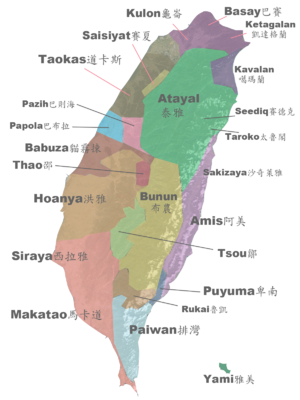
Here is a link to the map of Taiwan showing the distribution of Austronesian languages, even the ones that were culturally obliterated by Sinification.