A Taiwan TetralogyMost works on Taiwan try to fit the many aspects of its diverse past under one roof, too often ending up belittling one, championing another and cheating a third in that effort. Even if they claim or pledge neutrality and a pervasive ambition to cover all, to a close reader their rhetoric eventually betrays them. This tetralogy presents four crucial perspectives needed in approaching and understanding Taiwan; it may raise more questions than it answers but in its effort, it points directly to areas that cannot be ignored. It comes not only from reading and research but from having lived for over two decades in Taiwan and simply yet constantly and critically watching and integrating how too often actions and results speak louder than words. This includes a look at those who hold wealth, position and power in Taiwan, how they got it, and why the playing field of Taiwan’s democracy is still not level.
Book I
Island in the Stream: a Quick Case Study of Taiwan’s Complex History 
Island in the Stream (co-authored by Jerome F. Keating Ph.D. with April C. J. Lin Ph.D.) is a compact, concise history of Taiwan from 1500 to the present. Using Chinese, Japanese and western sources it gives a balanced presentation and is designed to be read and completed on a plane coming to Taiwan enabling any reader to be up to speed on Taiwan upon landing. Of course it can also be read by anyone on the ground. An added feature of this work is the list of provocative questions at the end of each chapter. These questions raise issues (often overlooked in other interpretations) that the reader will need to examine and answer if he/she wishes to grasp the complexity of Taiwan’s formative past. The first edition was published in 2000; subsequent editions were published in 2001, 2005, and 2008 making it one of the most current and up to date histories. The fourth edition (2008) is in its 2nd printing; a fifth edition is planned for 2012 after the results of the Presidential and Legislative Yuan elections.
Book II
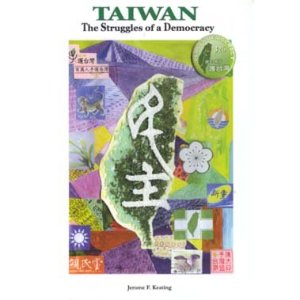
Taiwan: the Struggles of a Democracy
This book examines the past, present and future of Taiwan’s long struggle for democracy. It uses the African proverb, “Until lions have historians, the tales of the hunt will always glorify the hunter,” as its guiding theme. Most past accounts or histories of Taiwan’s struggle for democracy have been told from the standpoint of the Chinese Nationalist Party (KMT) which because of its long-standing martial law, White Terror, and one-party state rule fits the role of the hunter in the proverb. The voice of the Taiwanese (the lions) and their perspective and role in the struggle has long been ignored or overlooked. While post WWII Japan and Germany achieved democracy in less than a decade, Taiwan ironically took some four decades to reach such; the KMT hindered rather than helped the cause of democracy in Taiwan. (Publication 2006)
Book III
Taiwan: the Search for Identity
This is the most current and pressing issue that Taiwan faces and needs to resolve in order to determine its place and direction in the world. Despite the achievement of its full citizenry being able to democratically elect its Legislative Yuan (1992) and President (1996), Taiwan has still to work out its identity. Taiwan is made up of many waves of colonials and diaspora that interacted with its indigenous people. The indigenous people themselves were never united but only tribal in their outlook on life. Nonetheless, because of intermarriage and interaction with those that came to Taiwan, the various indigenous tribes have had their own influence that is an integral part of Taiwan’s identity. Too often this has been ignored, neglected and/or misunderstood. Further, the most recent diaspora to come, colonize and exploit Taiwan have been the Chinese Nationalist Party (KMT) that lost China. Unfortunately some of them still hanker for a mythic return to the continent and/or are reluctant to accept the true dimensions of the role that democracy must play in Taiwan. This along with the contributions and role of the indigenous people and other colonizers remains the issue yet to be resolved in Taiwan achieving full identity. (Publication 2008)
Book IV
The Mapping of Taiwan: Desired Economies, Competing Monopolies -- New Perspectives on Cartography, Competing Monopolies, and the Destiny of Taiwan.
The Mapping of Taiwan steps back and places Taiwan within the shaping framework of world events and global economies. It is a Gestalt of Taiwan's history and of life, but from the crasser standpoint of trade, commodities, greed and monopolies. Such are all part and parcel of desired economies that often in turn lead to coveted geographies that must be mapped. This book (80 to 85 all color pages of maps and photographs that along with 50 pages of text/context) traces the historical mapping of Taiwan by numerous nations from the 1500s to the present. Included are developments in cartography, the various mapmaking houses and the artistry of maps.
At a different level the book examines how the West came to Asia for the Spice Islands and how Taiwan was later drawn out of its isolation into a vortex of the desired economies and competing monopolies of various nations. Some nations eventually coveted it and colonized it. Taiwan had for a long time been mapped by outsiders, however it can now direct its own economy and map itself.
In a larger framework and larger vortex (a Gestalt of Life?) deconstructing the maps reveals hidden agendas and unsaid messages of people and nations following a variety of competing personal and national paradigms of religion, individualism, greed, power, patriotism, ideologies etc. etc. This book keeps its focus on the mapping of Taiwan, but it also points to these much wider dimensions of life. Maps convey information, yet what seems to be an event is really a construct of a specific quasi symbolic system conveying information. Visuals have their own message, but encoded in them also are multiple other messages to be deconstructed. Cartographers in turn have their own multiple motivations and constraints in making maps. A coffee table size book published in 2011.
- Jerome Keating, Ph.D.